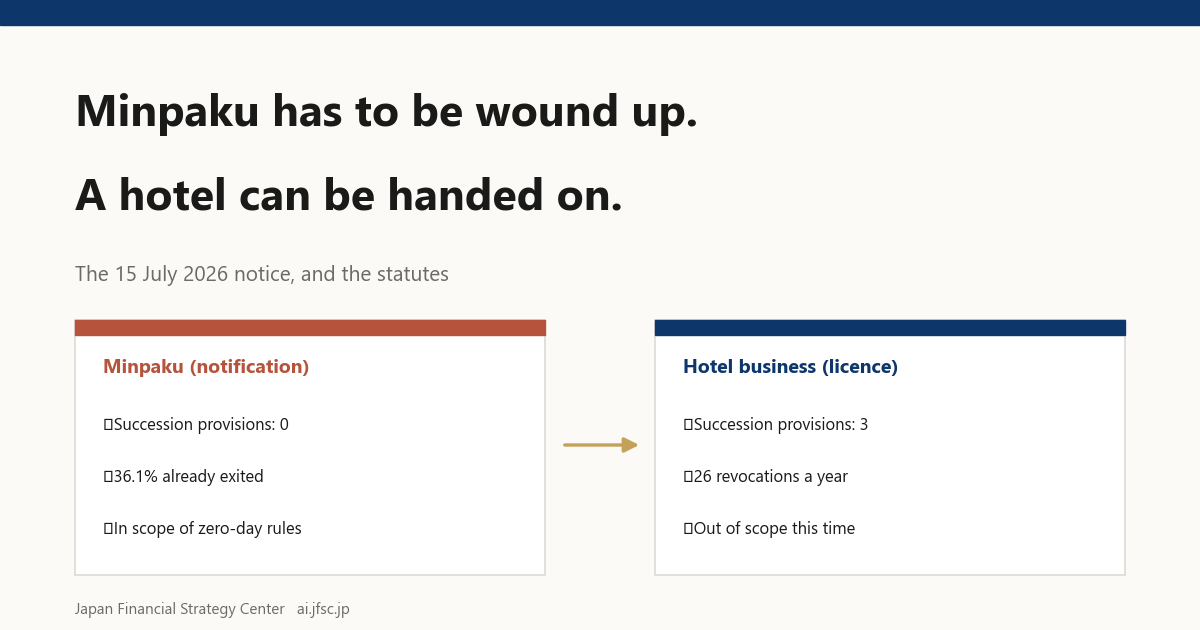
On 15 July 2026 the Japanese government changed how private lodging is treated. A notice now permits, under conditions, the "zero-day regulation" that the 2017 guideline had called inappropriate. But the point of this article is not how strict the rules are. Between private lodging and the hotel business there has always been a difference in the structure of the statutes themselves. One has three provisions for handing the business to the next owner. The other has none.
Start with what the notice actually is.
"Zero-day regulation of notified dwellings under the Private Lodging Business Act (technical advice)" (Ken-sei-ei-hatsu 0715 No. 1 / Koku-fu-dou No. 129 / Kan-kan-san No. 78), dated 15 July 2026, issued jointly by the Director of the Environmental Health Division of the Ministry of Health, Labour and Welfare, the Director of the Real Estate Industry Division of the Ministry of Land, Infrastructure, Transport and Tourism, and the Director of the Tourism Industry Division of the Japan Tourism Agency. It is addressed to the prefectural, public-health-centre-city and special-ward officials responsible for private lodging, and takes the form of technical advice under Article 245-4(1) of the Local Autonomy Act.
Where the turn lies is stated in a single footnote on the summary sheet.
Note: the guideline (December 2017) had treated zero-day regulation as "not appropriate."
That has now been replaced by this.
Zero-day regulation of notified dwellings may, in light of recent implementation, be carried out in cases such as those described below, at the discretion of each local government, within the limits reasonably deemed necessary.
Two situations are contemplated. Where, near residential areas or educational facilities, frequent guest traffic would damage a quiet living environment or the wholesome environment of schools. And where the maintenance of the settled population or of the local community would become difficult. In each case, prohibiting new private lodging, or limiting operating days to weekends and days before public holidays, is given as an example.
Not only new entrants.
Where, in such an area, a large number of private lodging operations are already being conducted and a quiet living environment is presently being significantly impaired, and where a strong necessity is recognised and no other appropriate measure exists, it is also conceivable to impose restrictions on existing notified dwellings — prohibiting operation, or limiting operating days to weekends and days before public holidays — after providing a certain grace period.
This is not framed as making past operation unlawful retroactively; it restricts operation prospectively, after the ordinance takes effect. That is why the words "after providing a certain grace period" are there. The practical effect, nonetheless, is that the business can no longer operate.
Before the regulatory question, look at what was already happening.
Japan Tourism Agency figures on notifications, as of 15 July 2026:
| Count | |
|---|---|
| Notifications (cumulative) | 65,837 |
| Business discontinuations | 23,767 |
| Notified dwellings (current) | 42,070 |
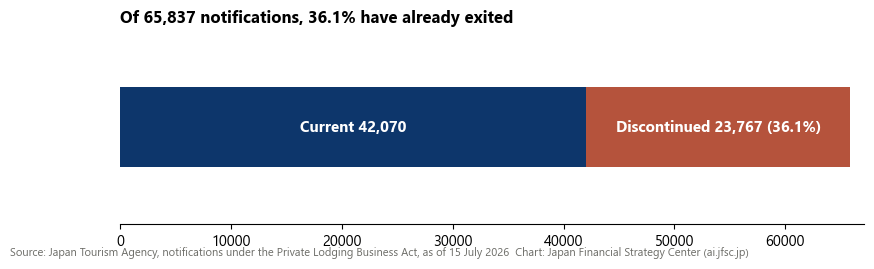
More than one in three had already exited. A discontinuation rate of 36.1%.
By municipality the spread is wide.
| Municipality | Notifications | Discontinued | Current | Rate |
|---|---|---|---|---|
| Osaka City | 6,201 | 3,945 | 2,256 | 63.6% |
| Hiroshima City | 691 | 380 | 311 | 55.0% |
| Katsushika Ward | 800 | 406 | 394 | 50.7% |
| Sapporo City | 6,075 | 3,034 | 3,041 | 49.9% |
| Taito Ward | 2,413 | 1,040 | 1,373 | 43.1% |
| Minato Ward | 1,490 | 616 | 874 | 41.3% |
| Shibuya Ward | 3,052 | 1,207 | 1,845 | 39.5% |
| Shinjuku Ward | 5,496 | 1,721 | 3,775 | 31.3% |
| Kyoto City | 1,818 | 503 | 1,315 | 27.7% |
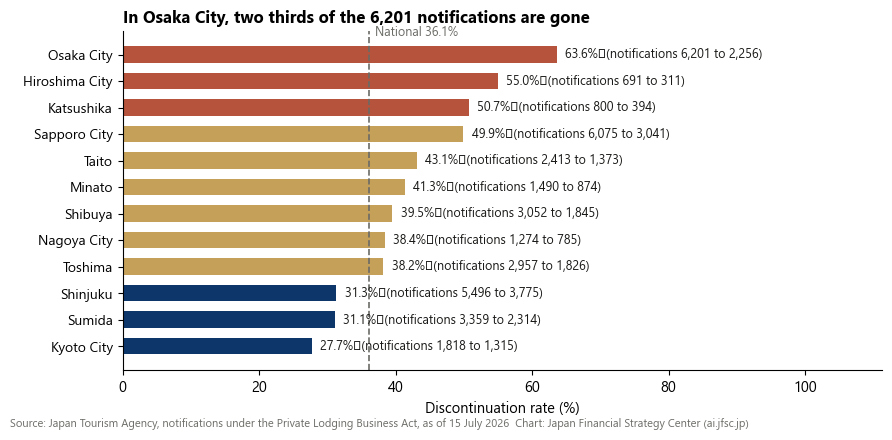
In Osaka City, 3,945 of 6,201 notifications were discontinued and 2,256 remain. Two thirds have gone.
The annual limit of 180 nights is the figure usually quoted. The operating data says something else.
Over the two months from 1 April to 31 May 2026, total nights nationwide came to 624,088 (138.6% of the same period a year earlier). Per notified dwelling that is 17.9 days — about 107 days on an annual basis.
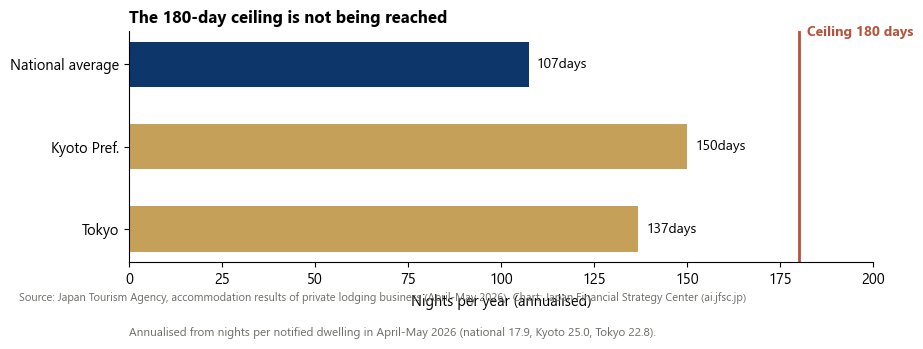
The ceiling is 180. The average is not reaching even 60% of it. The highest prefecture, Kyoto, managed 25.0 days and Tokyo 22.8 — annualised, 150 and 137 days.
For most operators, in other words, the economics bit before the ceiling did. The 36.1% discontinuation rate reads as the result.
Of the 626,765 guests in that period, 391,174 — 62.4% — were foreign nationals. Notified dwellings stood at 41,207 as of 31 May, with a reporting rate of 84.7%.
How strict the rules are changes with the times. The structure of the law does not.
The Hotel Business Act contains three provisions for passing the business on.
Article 3-2 (transfer of the business)
Where a person who operates a hotel business under the licence referred to in paragraph 1 of the preceding Article (hereinafter "operator") transfers that hotel business, and the transferor and transferee obtain the approval of the prefectural governor for the transfer and acquisition, the transferee succeeds to the status of operator.
Article 3-3 (merger and demerger)
In the case of a merger of an operator that is a corporation ... or a demerger ... where the approval of the prefectural governor is obtained for the merger or demerger, the corporation surviving the merger, the corporation established by the merger, or the corporation that succeeded to the hotel business through the demerger succeeds to the status of operator.
Article 3-4 (inheritance)
The heir applies to the governor within 60 days of death and obtains approval. Paragraph 2 provides that, between the death and the day approval or refusal is notified, the licence granted to the deceased is deemed to have been granted to the heir. It is built so that no gap in operation arises.
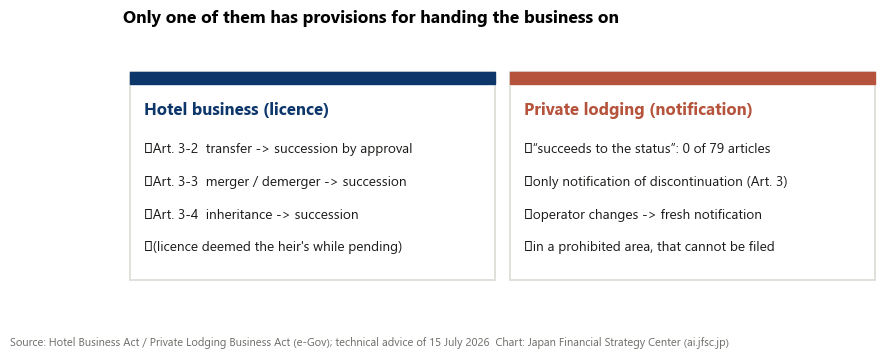
The Private Lodging Business Act has nothing equivalent. Across its 79 substantive articles, the phrase "succeeds to the status" does not appear once. What Article 3 contains is a notification of discontinuation: when an individual operator dies, when a corporation is extinguished by merger, when it is dissolved by a decision commencing bankruptcy proceedings. In each case, you file a notice and it ends.
Which is why the notice has to say this.
Where, after new private lodging operations have been prohibited, a change occurs in the private lodging business operator (the person who filed the notification), a fresh notification under Article 3 of the Act is required; accordingly, private lodging operations cannot be continued at that notified dwelling.
With no succession provision, a change of operator means a new notification. And in a prohibited area, that new notification cannot be made.
This is where confusion arises, so take it separately.
Zero-day regulation by ordinance attaches to the area. A notified dwelling in that area cannot operate, whoever owns it. Selling the company so that the notifying entity does not change makes no difference to the restriction itself.
What a share transfer avoids is only the succession problem.
| Inside a prohibited area | Outside | |
|---|---|---|
| Minpaku, business transfer | Cannot operate | New notification required (no succession provision) |
| Minpaku, share transfer | Cannot operate | Operator unchanged, so it continues |
| Hotel business | Not within the scope at all | Article 3-2 succession; share transfer needs no procedure |
Private lodging is caught twice. In a restricted area it ends. Outside one, it still cannot be passed on by business transfer. The share transfer route solves only the second, and the first applies to any buyer.
The notice is addressed to officials responsible for private lodging, and its subject is notified dwellings. On the hotel business it says only this:
Attention should be paid to consistency with related regulation, such as the urban planning of the area concerned (locational restrictions on accommodation facilities) and the operation of licensing for accommodation facilities near educational facilities under Article 3(3) of the Hotel Business Act.
The two instruments named there are urban planning and Article 3(3) of the Hotel Business Act. Neither was created by this notice. Article 3(3) permits refusal of a licence where the site lies within roughly 100 metres of a school, child welfare facility, social education facility and the like, and the wholesome environment of that facility would be significantly harmed — a provision that has been on the books since 1948. Not one new restriction has been added.
| This notice | |
|---|---|
| Private lodging (notified dwellings) | In scope. Zero-day regulation permitted; may reach existing dwellings with a grace period; cannot continue if the operator changes |
| Hotel business (licensed) | Out of scope. Only a note to observe consistency with the existing Article 3(3) and urban planning |
Ministry of Health, Labour and Welfare figures (Report on Public Health Administration and Services, FY2024):
| Facilities | |
|---|---|
| Hotel and inn operations | 52,946 (1,782,232 rooms) |
| Simple lodging operations | 44,901 |
| Boarding house operations | 491 |
| Total | 98,338 |
An average of 33.7 rooms per hotel or inn.
Movement during the year:
| Count | |
|---|---|
| Licences granted | 7,720 |
| Businesses closed | 2,817 |
| Licences revoked | 26 |
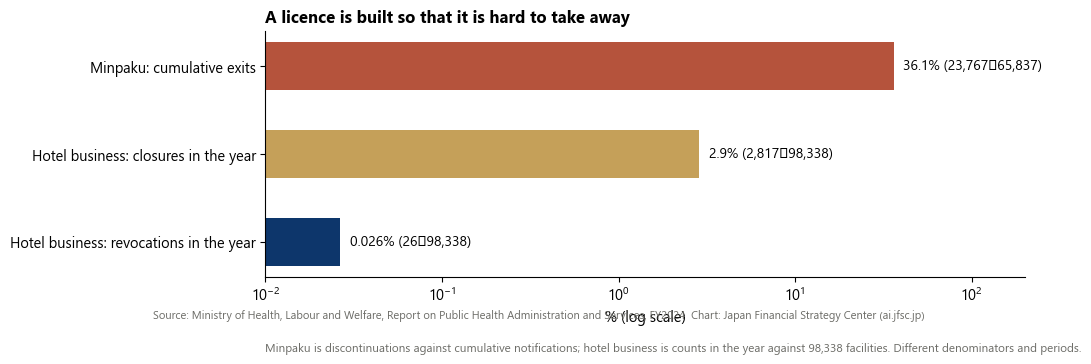
Twenty-six revocations against 98,338 facilities. Less than 0.03%.
Private lodging has lost 36.1% of its cumulative notifications and, in some areas, will soon be unable to operate at all. Hotel licences are revoked 26 times a year. That gap is less about the severity of enforcement than about what kind of instrument each is. A licence is built so that it is hard to take away.
Pulled into one line:
If you are entering accommodation, acquire a facility that holds a licence rather than one that filed a notification. The acquisition can be structured as a share transfer or as a business transfer with the approval under Article 3-2. Private lodging does not offer that choice at all.
In an earlier article we found that accommodation scores well for a foreign owner on the operational constraints while carrying a heavy capital burden. What has changed is the way over that capital wall: from "start cheaply" to "buy the licence with the building."
Q. Is private lodging going to be banned?
Not nationwide. The notice of 15 July 2026 permits local governments to designate areas and impose restrictions by ordinance. What happens where depends on each ordinance. The notice does say that restrictions may also reach existing notified dwellings after a grace period.
Q. If I buy the company itself, can I avoid the restriction?
No. Restrictions by ordinance attach to the area and apply whoever the owner is. A share transfer avoids only the need to file a fresh notification — and only in an area that is not restricted.
Q. Can a private lodging business be handed to someone else?
The Private Lodging Business Act has no provision for succeeding to the status of operator; the phrase does not appear once in its 79 substantive articles. On a business transfer or an inheritance, the new operator files a fresh notification. In a prohibited area that notification cannot be made, so the business cannot continue.
Q. Can a hotel licence be taken over?
Yes. Article 3-2 (transfer), Article 3-3 (merger and demerger) and Article 3-4 (inheritance) each provide that, with the approval of the prefectural governor, the successor takes the status of operator. For inheritance, the licence granted to the deceased is deemed granted to the heir while the application is pending, so operation does not stop.
Q. Does this regulation apply to hotels and inns?
No. The subject of the notice is notified dwellings. On the hotel business it says only to observe consistency with existing urban planning and Article 3(3) of the Hotel Business Act. No new restriction was created.
Q. Can a simple lodging licence replace private lodging?
Simple lodging is a licence under the Hotel Business Act, not a notification, and the succession provisions of that Act apply to it. That said, the notice asks local governments, where they restrict private lodging to protect a quiet residential environment, to observe consistency by restricting simple lodging and the like as well. The instruments are urban planning and Article 3(3), and it is for each local government to decide.
Q. Is the 180-day limit really that tight?
Statistically, operation stops before reaching it. Nights per notified dwelling over April–May 2026 were 17.9, about 107 days annualised. Even Kyoto, the highest, was 25.0 days (150 annualised).
Q. Are hotel licences ever revoked?
They are. In FY2024 there were 26 revocations, against 98,338 hotel-business facilities — under 0.03%.
Private lodging
Hotel business
Statutes (verified via e-Gov)

This article is compiled from published data of Japan's National Tax Agency Corporate Number Publication Site, materials published by the Bank of Japan, the Ministry of Finance, the Immigration Services Agency, the National Tax Agency and the Ministry of Health, Labour and Welfare, a survey by the Japan Finance Corporation Research Institute, and statutory text from e-Gov. It does not determine or guarantee the outcome of any particular transaction.
The merger figures cover only transactions structured as mergers; share transfers and business transfers are not included. Seller size is limited to cases matched against a licence register, and in some sectors the base is very small. These limits are stated at the relevant points in the text.
Under Japanese law, preparing licence-succession and residence-status applications is reserved to qualified professionals. This article explains the data and the framework; it does not prepare filings or act as an agent.
Errors are possible. If you notice one, please tell us via the contact form and we will check and correct it promptly.
横にスクロールして拡大部分を見られます。クリックで閉じる