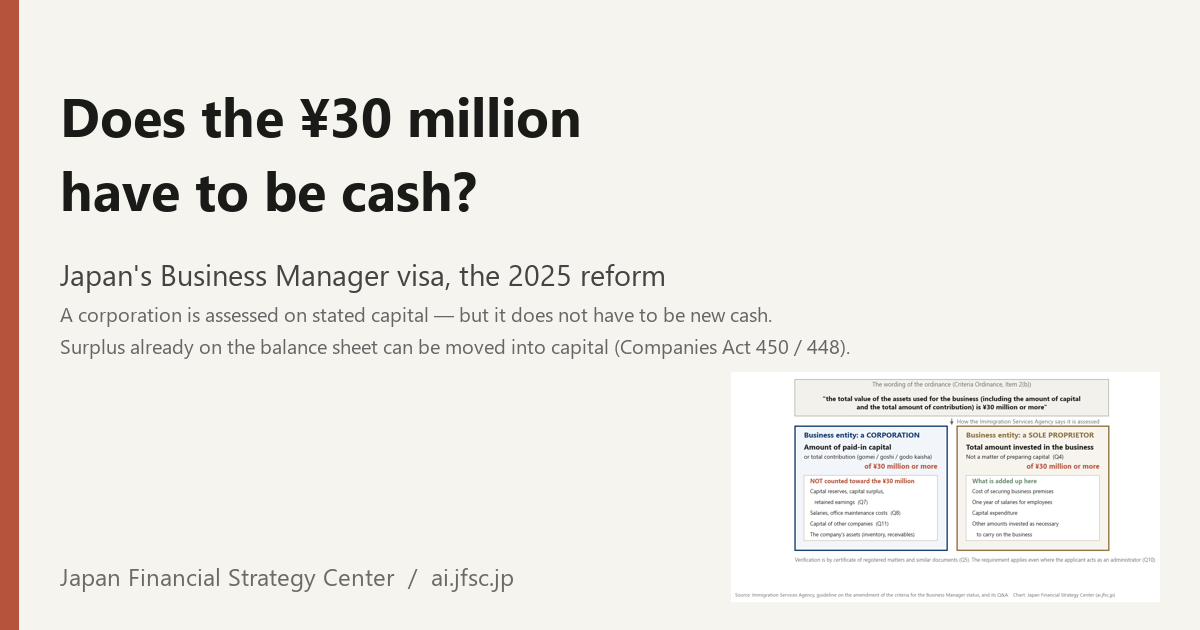
On 16 October 2025, the criteria for Japan's Business Manager residence status changed. For a corporation, the ¥30 million is assessed on the amount of stated capital. It does not, however, have to be new cash: surplus and reserves already on the balance sheet can be moved into stated capital by a resolution of the shareholders (Companies Act Articles 450 and 448). Where there is no surplus to move, money does have to go in. A sole proprietor is not assessed on capital at all, but on the total invested in the business. This article works from the ordinance, the Immigration Services Agency's guideline, the application form and the Agency's Q&A.
<a href="https://jfsc.jp/en/research/keiei-kanri-visa-reform/">Does the ¥30 million have to be cash? — Japan's Business Manager visa, the 2025 reform | Japan Financial Strategy Center, Inc.</a>Plain-text citation:Japan Financial Strategy Center, Inc., "Does the ¥30 million have to be cash? — Japan's Business Manager visa, the 2025 reform" (16 September 2026) https://jfsc.jp/en/research/keiei-kanri-visa-reform/The amendment was made by Ministry of Justice Ordinance No. 50 (promulgated 10 October 2025, in force 16 October 2025). It rewrote the Business Manager entry in the Ministerial Ordinance on Criteria under Article 7(1)(ii) of the Immigration Control Act.
| Before | After | |
|---|---|---|
| Chapeau | The scale of the business falls under either of the following | The scale of the business falls under both of the following |
| (a) | The business is carried on by two or more full-time employees residing in Japan (excluding those residing under a status listed in Appendix I of the Act) | The business is carried on by full-time employees residing in Japan (same exclusion) |
| (b) | The amount of capital or the total amount of contribution is ¥5 million or more | The total value of the assets used for the business (including the amount of capital and the total amount of contribution) is ¥30 million or more |
| (c) | A scale equivalent to (a) or (b) | Deleted |
Two further requirements were added.
Sources: Ministry of Justice Ordinance No. 50, and the parent page, Immigration Services Agency: Amendment of the Criteria for the Business Manager status.
This article may be quoted freely with a link to the source (CC BY 4.0). A ready-made citation tag is in the box near the top of the page.
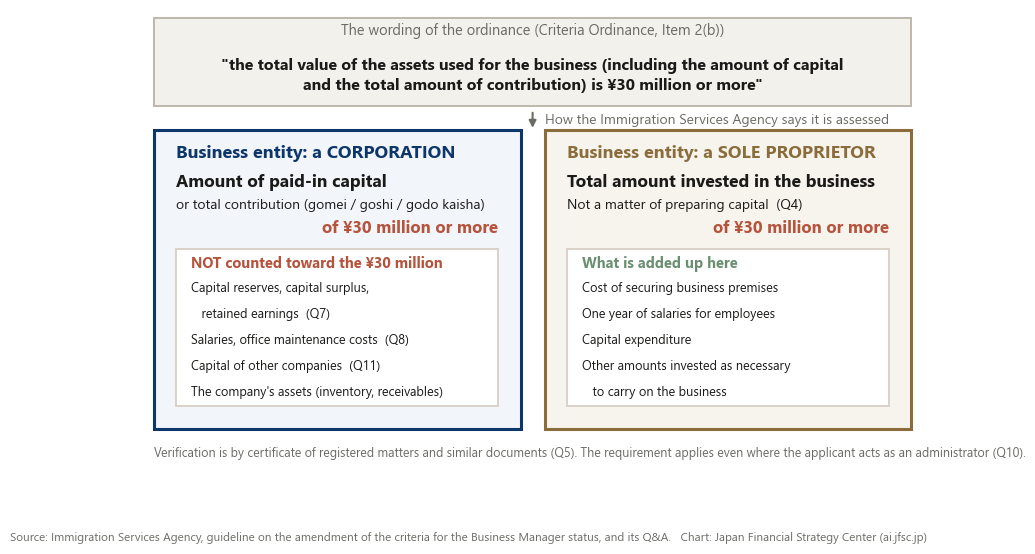
The wording of the ordinance is "the total value of the assets used for the business (including the amount of capital and the total amount of contribution)." Read on its own, it sounds like the company's balance sheet total.
The Immigration Services Agency's guideline on the amendment states plainly what is assessed.
2. Capital and equivalent
A business scale of ¥30 million or more in capital or equivalent is required (Item 2(b)).
(Note) Where the business entity is a corporation: this refers to the amount of paid-in capital (the amount of stated capital) of a kabushiki kaisha, or the total amount of contribution of a gomei kaisha, goshi kaisha or godo kaisha.
Where the business entity is an individual: this refers to the total amount invested as necessary to carry on the business, such as securing business premises, one year of salaries for employees, and capital expenditure.
For a company, it is capital. The section of the guideline is headed "Capital and equivalent."
To be precise about where on the balance sheet this sits: it is not the total of the assets side, and it is not assets minus liabilities. For a kabushiki kaisha it is the figure in the "stated capital" line within net assets. A company with ¥100 million in total assets and ¥50 million in net assets, but ¥5 million in stated capital, is a ¥5 million company for this purpose. Conversely, a company carrying heavy debt still meets this requirement if its stated capital is ¥30 million. How much debt there is does not enter into it.
The Agency's Q&A on the same page addresses this directly.
Q7. Under the old criteria the requirement was "the amount of capital or the total amount of contribution." Under the new criteria it is "the assets used for the business." Do capital reserves, capital surplus and retained earnings count as "assets used for the business"?
A. "The total value of the assets used for the business" refers, where the business entity is a corporation, to the amount of paid-in capital (the amount of stated capital) of a kabushiki kaisha or the total amount of contribution of a gomei kaisha, goshi kaisha or godo kaisha. Therefore capital reserves, capital surplus and retained earnings are not included.
A company that has accumulated ¥30 million of retained earnings over many years, while its stated capital has stayed at ¥5 million, does not meet the requirement on those retained earnings alone. It can, however, move them (see the column below).
Q8. For the new ¥30 million criterion, where the business entity is a corporation, is it correct that the criterion is met if the amount of capital plus employee salaries, office maintenance costs and the like together exceed ¥30 million?
A. Where the business entity is a corporation, the judgment is made on the amount of capital or the total amount of contribution, so these cannot be aggregated with amounts invested as necessary to carry on the business, such as employee salaries or office maintenance costs.
The broad phrase "assets used for the business" is not there for companies. It is there for sole proprietors, who have no concept of stated capital. For them, the Agency adds up what has actually been put into the business: premises, one year of salaries, capital expenditure.
Q4. I have heard that a sole proprietor also has to prepare ¥30 million in capital. Is that right?
A. That is not correct. (...) Where the business entity is an individual rather than a corporation, it is not a matter of preparing capital; it refers to the total amount invested as necessary to carry on the business, such as securing business premises, one year of salaries for employees, and capital expenditure.
Q11. Where a person manages or administers several companies and the capital of those companies together comes to ¥30 million or more, is the requirement met?
A. One of the companies must have a business scale of ¥30 million or more in capital.
Three companies with ¥10 million each will not do. One company must be at ¥30 million.
The requirement also applies where the applicant acts as an administrator rather than an owner (Q10). Verification is by certificate of registered matters and similar documents (Q5). Where the first accounting period has not yet closed, a balance sheet drawn up as at incorporation or any later date is to be submitted (Q6).
Source: Guideline on the amendment (published 10 October 2025, updated 30 October 2025) and the Q&A on the parent page.
Reserves and retained earnings do not count as they stand. Once moved into stated capital, they are stated capital. Japan's Companies Act provides two routes.
Article 450 (Increase in the Amount of Stated Capital). A Stock Company may reduce the amount of surplus and increase the amount of stated capital.
(2) The matters listed in each item of the preceding paragraph shall be decided by resolution of a shareholders meeting.
(3) The amount under item (i) of paragraph (1) may not exceed the amount of surplus as at the day under item (ii) of that paragraph.
Article 448 (Reduction in the Amount of Reserves). A Stock Company may reduce the amount of Reserves. In such cases, the following matters shall be decided by resolution of a shareholders meeting:
(i) the amount of the Reserves to be reduced;
(ii) if all or part of the amount of the Reserves to be reduced is to be made stated capital, a statement to that effect and the amount to be made stated capital.
No new cash payment is required. What is on the balance sheet is moved from one line of net assets to another.
Take a company with ¥25 million in retained earnings and ¥5 million in stated capital. Net assets are ¥30 million. For the purposes of the criterion, it has been a ¥5 million company.
A shareholders' resolution reducing surplus by ¥25 million and increasing stated capital by the same amount leaves retained earnings at zero and stated capital at ¥30 million. Net assets are still ¥30 million. Not a yen has moved. What moved was a line within net assets.
After the resolution, a registration of change in the amount of stated capital is filed. The cost is registration and licence tax.
Registration and Licence Tax Act, Appended Table 1, item 24(1)(d). Registration of an increase in the stated capital of a kabushiki kaisha or godo kaisha: the amount of the increase in stated capital, 7/1000 (where the tax so calculated is less than ¥30,000, ¥30,000 per application).
Capitalising ¥25 million costs ¥175,000. That is a different order of magnitude from finding ¥30 million in cash.
What is not there cannot be moved. Article 450(3) caps the reduction at the amount of surplus actually held. A company with years of losses and no surplus, or a company incorporated recently, has no route here. Companies that fall short of the criterion divide into those that can fix it by resolution and those that must actually put money in. The net assets section of the most recent balance sheet tells you which.
The same applies when acquiring a company. Acquire a company that holds surplus, by share transfer, and that surplus can be capitalised so that the company meets the requirement.
In a share transfer the legal entity does not change. Licences and permits stay with the entity; there is nothing to succeed to and nothing to re-obtain. Stated capital and surplus also stay with the entity, so a company with ¥30 million in stated capital still has ¥30 million after the shares change hands.
In a business transfer the legal entity does change. Licences and permits are not, as a rule, carried over, and the transferee has to obtain them again. The transferee's own stated capital does not increase merely because it has bought a business.
Restaurant business permits, real estate brokerage licences, designation as a long-term care provider, warehousing registration — the same logic applies to all of them. Buy the company and they remain; buy only the business and they must be obtained afresh.
Once stated capital rises, the per capita levy of local corporate inhabitant tax is set by bands of capital and equivalent, so crossing a band changes the amount. At ¥100 million or below, treatment as a small and medium-sized enterprise under the tax rules is retained.
Capitalising surplus is a Companies Act procedure; the registration is handled by a judicial scrivener and the tax analysis by a certified public tax accountant. Please consult each of them before acting.
It is often said that an obligation to employ at least one full-time employee was newly introduced. The ordinance took a slightly different path.
The wording of item (a) existed before the amendment. The number went down, from "two or more" to no stated number, that is, one or more.
What changed is the chapeau: "either" became "both." Before the amendment it was enough to satisfy one of (a) employing two or more people, (b) ¥5 million in capital, or (c) an equivalent scale. In practice (b) was chosen, which is why employing nobody was workable. Making it "both" means (a) and (b) are now required together. The employment requirement was not written in; it stopped being optional. At the same time (c), "an equivalent scale," was deleted, so the room to fall short and still qualify is gone.
The parenthesis in item (a) excludes "those residing under a status listed in Appendix I of the Act." That exclusion predates the amendment and survives it.
Appendix I includes Technical Intern Training, Specified Skilled Worker, Engineer/Specialist in Humanities/International Services, Skilled Labor and Intra-company Transferee. Employees working under those statuses do not count as the full-time employee the criterion requires. Those who count are Japanese nationals, Special Permanent Residents, and holders of Appendix II statuses: Permanent Resident, Spouse or Child of Japanese National, Spouse or Child of Permanent Resident, and Long-Term Resident.
The Japanese-language requirement under Item 3 works differently: there, "persons who work in the business" does include Appendix I holders. The same phrase carries a different scope in different items. The Agency's Q&A acknowledges the confusion and gives examples.
Examples that meet the criteria
Examples that do not
A business run by a foreign national and staffed by foreign nationals is not unusual. Such a business now has to hire one Japanese national or Appendix II holder, at a time when Japan is short of labour.
The Q&A also sets out what "full-time" means: five or more working days per week and 217 or more days per year, 30 or more working hours per week, at least ten days of annual paid leave after six months of continuous service with 80% attendance, and enrolment in employment insurance. Workers engaged through secondment, dispatch or subcontracting are not counted as full-time employees of the establishment where they work (Q3).
"Permanent residence has become harder" is a common line. The provision on permanent residence was not touched. Article 22 of the Immigration Control and Refugee Recognition Act reads:
Article 22. A foreign national who wishes to change his or her status of residence to that of Permanent Resident shall apply to the Minister of Justice for permission for permanent residence, pursuant to the procedures provided for by Ministry of Justice ordinance.
(2) Where an application has been submitted, the Minister of Justice may grant permission only when the person conforms to both of the following items and the Minister considers that the person's permanent residence accords with the interests of Japan. However, where the person is the spouse or child of a Japanese national, of a person granted permanent residence, or of a Special Permanent Resident, conformity with the following items is not required. (...)
(i) The person's conduct is good.
(ii) The person has sufficient assets or skills to make an independent living.
Two items, plus the "interests of Japan" test in the chapeau. The Agency's guidance states a standard processing period of four to six months and no procedure for administrative appeal (Application for Permanent Residence).
The guideline on the amendment contains this sentence:
After the date of entry into force, where the criteria as amended are not met, permission for permanent residence from Business Manager, Highly Skilled Professional (i)(c) or Highly Skilled Professional (ii) (limited to those premised on Business Manager activities), and permission to change status from Highly Skilled Professional (i)(c) to Highly Skilled Professional (ii), will not be granted.
The bar was not raised. Those who do not meet the Business Manager criteria can no longer reach the permanent residence examination at all. The gate is the same height; the road to it changed.
One further point is easily conflated. An act amending the Immigration Control Act was promulgated on 5 June 2026 (Act No. 32 of 2026).
It does two things: it revises the fees for applications such as change of status of residence (to come into force on a date to be fixed by cabinet order, no later than 31 March 2027), and it creates JESTA, an electronic travel authorisation system (no later than 31 March 2029). It contains neither a revocation of permanent residence nor any amendment to the permanent residence requirements (Immigration Services Agency page).
Those already residing under Business Manager have three years.
Q1. Will a person who has been residing under Business Manager since before this amendment have an extension application refused during the three years after entry into force, simply for not meeting the new criteria?
A. Until three years have passed from entry into force (16 October 2028), an application for extension of period of stay will not be refused solely on the ground that the new criteria are not met.
Nor is refusal automatic after that.
Q3. (On the claim that a person who cannot raise ¥30 million within three years must leave Japan.)
A. That is not correct. On an application for extension filed after three years from entry into force, even where the amended criteria are not met, if the business is in good condition, corporate tax and other obligations have been properly performed, and the criteria are expected to be met by the next extension, the decision will be made taking the overall circumstances into account. (...) It is not the case that an application will uniformly be refused solely because the figure falls short of ¥30 million.
Applicants may be asked to submit a document assessed by a management professional. At extension, the Agency checks enrolment in and payment of labour and social insurance, and payment of withholding income tax, corporation tax, consumption tax, and local corporate inhabitant and enterprise taxes.
The Q&A adds that even where the business and tax position are sound, problems with compliance under the Labour Standards Act or the Minimum Wage Act, with social insurance enrolment, or with obtaining the permits the business needs, are treated as negative factors and have resulted in refusals (Q2).
The guideline also states that where the applicant outsources the work and cannot be shown to be genuinely engaged in management, the activity is not treated as falling under Business Manager; that using one's home as the business premises is not, as a rule, accepted; and that extension will not be granted where the applicant has spent long periods outside Japan without good reason.
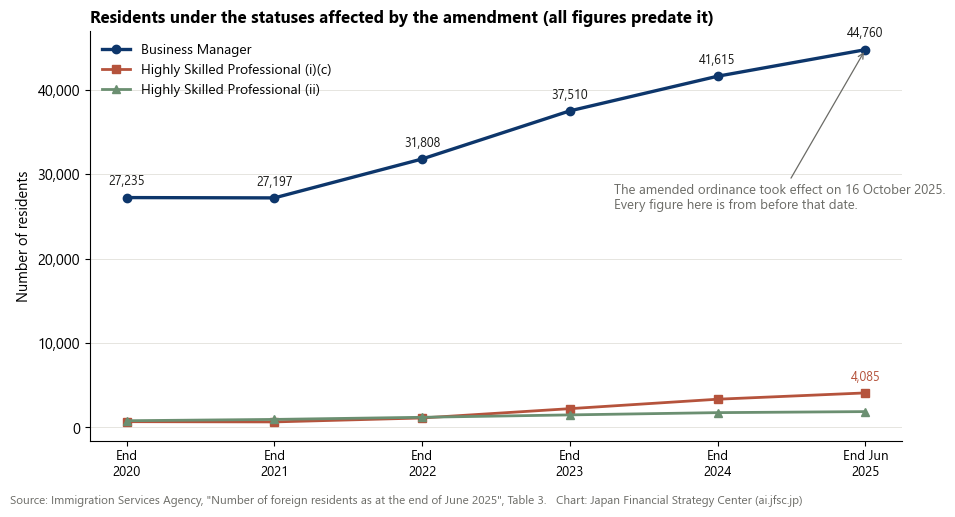
At the end of June 2025, 44,760 people were residing in Japan under Business Manager, up from 27,235 at the end of 2020.
| Status | End 2020 | End 2022 | End 2023 | End 2024 | End June 2025 |
|---|---|---|---|---|---|
| Business Manager | 27,235 | 31,808 | 37,510 | 41,615 | 44,760 |
| Highly Skilled Professional (i)(c) | 676 | 1,116 | 2,219 | 3,338 | 4,085 |
| Highly Skilled Professional (ii) | 789 | 1,197 | 1,480 | 1,748 | 1,870 |
Source: Immigration Services Agency, Number of foreign residents as at the end of June 2025, Table 3.
All of these figures predate the amendment; the latest count, end June 2025, falls before the 16 October 2025 commencement. What happened afterwards appears not in the residence statistics but in the Diet record. On 14 April 2026, in the House of Councillors Committee on Cabinet, a government official stated that applications for certificates of eligibility — covering Business Manager and part of Highly Skilled Professional — ran at a monthly average of about 1,700 in the five and a half months to 15 October 2025, and about 70 in the five and a half months from 16 October 2025 to 31 March 2026: a fall of about 96%. The figures were compiled as approximations to capture the position before and after the change, not as regular statistics.
On nationality, a government official stated on 22 May 2025 that of 39,616 people holding the status as at the end of June 2024, the top three were China at about 52%, South Korea at about 7% and Nepal at about 7%. A finer breakdown for the end of 2019, cited in a paper by the Japan Finance Corporation Research Institute, gives China 53.0%, South Korea 11.3%, Nepal 5.8%, Pakistan 4.7%, Sri Lanka 4.5%, Taiwan 3.2% and the United States 2.5%.
Note that the ranking differs from the foreign population as a whole. At the end of June 2025 the second largest nationality among all foreign residents in Japan was Vietnam, at 660,483. Vietnam does not appear in the top three for Business Manager. The number of people who come to work and the number who come to run a business are different lists.
We also publish a Simplified Chinese article on acquiring a Japanese company under this status.
It is worth checking whether the story "foreign nationals are leaving, so businesses close" holds. The same statistical table gives the work-side statuses.
| Status | End 2020 | End June 2025 | Multiple |
|---|---|---|---|
| Specified Skilled Worker | 15,663 | 336,196 | 21.5× |
| of which SSW (ii) | 0 | 3,073 | — |
| Engineer/Specialist in Humanities/International Services | 283,380 | 458,109 | 1.62× |
| Technical Intern Training | 378,200 | 449,432 | 1.19× |
| Business Manager | 27,235 | 44,760 | 1.64× |
| (Total) | 2,887,116 | 3,956,619 | 1.37× |
The work statuses have not contracted. Specified Skilled Worker multiplied 21.5 times in five and a half years. What was tightened was the management side.
There is no published statistical table showing the industries in which foreign-run businesses operate. The Economic Census has no axis for the nationality of the proprietor, and the residence statistics have no axis for industry.
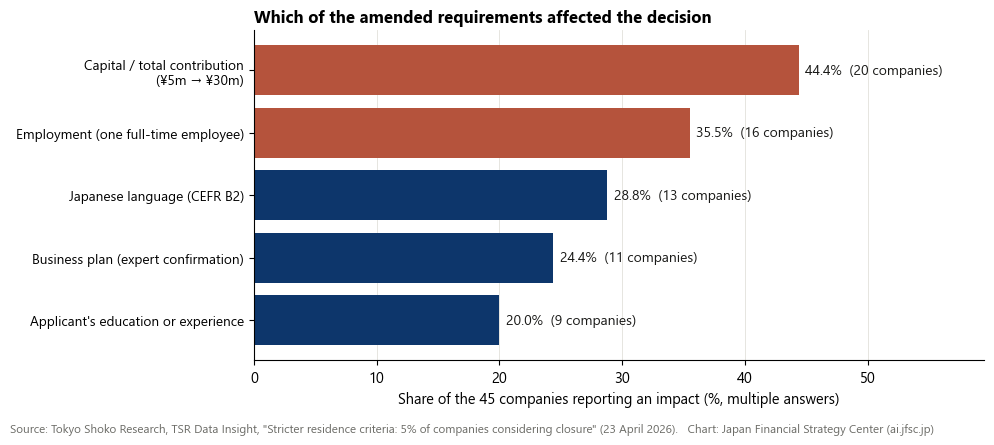
The Agency does hold the information: the application form has a field for industry. On 21 April 2026, in the House of Councillors Committee on Judicial Affairs, a government official said that a survey of the 41,615 people holding the status at the end of 2024 — conducted within the limits of what could be established from the most recent application forms — found that wholesale, retail and food services accounted for a large share, that a large share of holders were at or near the then-criterion of ¥5 million in capital, and that many were not employing full-time staff. Detailed figures, he added, could not be given.
Figures on how many already met the new threshold were given on 8 May 2026 in the House of Representatives Committee on Judicial Affairs: of those the Agency could establish, about 4% had capital of ¥30 million or more. A document submitted to the House of Councillors on 28 May 2026 put it at 73.9% at the ¥5 million level, 15.3% between ¥6 million and ¥10 million, and 4.1% at ¥30 million or above.
This article is based on statutory text, the Agency's guideline, the application form, the Agency's Q&A, published statistics and the Diet record. It does not assess whether any individual application will be granted.
Q. Does the ¥30 million have to be paid in as capital?
Where the business entity is a corporation, yes. The Immigration Services Agency's guideline and Q&A state that the assessment is made on the amount of paid-in capital of a kabushiki kaisha, or the total amount of contribution of a gomei kaisha, goshi kaisha or godo kaisha. Where the applicant is a sole proprietor it is not capital but the total amount invested in the business — premises, one year of employee salaries, capital expenditure and the like.
Q. I cannot raise ¥30 million in cash. Is there another way?
There are three. First, if the company already holds surplus or reserves, these can be transferred into stated capital (Companies Act Articles 450 and 448). No new payment is required; a shareholders' resolution and a registration of change are enough. Second, acquiring by share transfer a company that already has ¥30 million or more in stated capital satisfies the requirement for that company. Third, a sole proprietor is assessed not on capital but on the total invested in the business. In addition, those already residing under Business Manager have transitional measures until 16 October 2028, and the government has stated in the Diet that an application will not be refused solely because the threshold is not met.
Q. Can retained earnings be moved into stated capital?
Yes. Companies Act Article 450 provides that a stock company may reduce the amount of surplus and increase the amount of stated capital, by resolution of a shareholders meeting. A company with ¥5 million in stated capital and ¥25 million in retained earnings can become a company with ¥30 million in stated capital and no retained earnings. Net assets are unchanged at ¥30 million and no cash moves. The cost is registration and licence tax at 7/1000 of the increase, with a minimum of ¥30,000 — ¥175,000 on a ¥25 million capitalisation. Article 450(3) caps the reduction at the surplus actually held, so a company without surplus cannot use this. Capitalisation from reserves is under Article 448(1)(ii). The registration is a judicial scrivener's work and the tax analysis a tax accountant's.
Q. Do capital reserves and retained earnings count toward the ¥30 million?
Not as they stand. Q7 of the Agency's Q&A states that capital reserves, capital surplus and retained earnings are not included in "the total value of the assets used for the business." They count once transferred into stated capital.
Q. Can salaries and office costs be added to capital to reach ¥30 million?
Not for a corporation. Q8 states that the judgment is made on capital or total contribution, so such amounts cannot be aggregated. Aggregation applies to sole proprietors.
Q. I run several companies. Can their capital be combined?
No. Q11 states that one of the companies must have capital of ¥30 million or more.
Q. If I buy a company with ¥30 million or more in stated capital, is the requirement met?
For that company, yes; Q11 read the other way round says as much. In a share transfer the legal entity does not change, so capital and licences remain with it. In a business transfer the entity does change, licences generally have to be obtained again, and the buyer's own capital does not increase. Which company constitutes "the business to which the application relates," and where premises and full-time staff sit if a holding company is used, are matters of individual structuring.
Q. Can the full-time employee be a foreign national?
The employment requirement (Item 2(a)) excludes those residing under a status listed in Appendix I of the Act, so Technical Intern Training, Specified Skilled Worker and Engineer/Specialist in Humanities/International Services do not count. Japanese nationals, Special Permanent Residents and Appendix II holders (Permanent Resident, Spouse or Child of Japanese National, Spouse or Child of Permanent Resident, Long-Term Resident) do. The Japanese-language requirement under Item 3 is different: there, Appendix I holders are included.
Q. Does the applicant have to satisfy the Japanese-language requirement personally?
No. Item 3 refers to "any one of" the persons who manage or work in the business other than on a casual basis. Evidence may be JLPT N2 or above, 400 or more on the BJT Business Japanese Proficiency Test, 20 or more years of residence in Japan as a mid- to long-term resident, graduation from a Japanese higher education institution, or completion of Japanese compulsory education plus graduation from a Japanese high school.
Q. Have the requirements for permanent residence changed?
No. The requirements under Article 22 of the Immigration Control Act — good conduct, sufficient assets or skills for an independent living, and accordance with the interests of Japan — were not amended. What changed is that permission for permanent residence from Business Manager and related statuses is not granted where the amended criteria are not met.
Q. Did the June 2026 amendment introduce revocation of permanent residence?
No. Act No. 32 of 2026, promulgated on 5 June 2026, revises application fees and creates JESTA. It contains no revocation of permanent residence and no amendment to the permanent residence requirements.
Q. Can I use my home as the business premises?
The guideline states that using one's home as business premises is not, as a rule, accepted. It also states that where the work is outsourced such that the applicant cannot be shown to be genuinely engaged in management, the activity is not treated as falling under Business Manager.
Statutes and official materials
Research
In Japanese
The full version of this article, including the industry-by-industry capital data, the Diet debate in detail and the datasets in CSV, is published in Japanese: 「3,000万円」は、資本金だけではない
<a href="https://jfsc.jp/en/research/keiei-kanri-visa-reform/">Does the ¥30 million have to be cash? — Japan's Business Manager visa, the 2025 reform | Japan Financial Strategy Center, Inc.</a>Plain-text citation:Japan Financial Strategy Center, Inc., "Does the ¥30 million have to be cash? — Japan's Business Manager visa, the 2025 reform" (16 September 2026) https://jfsc.jp/en/research/keiei-kanri-visa-reform/
This article is an organised reading of the Ministry of Justice ordinance, the published materials and application forms of the Immigration Services Agency, statutory text from the e-Gov legal database, official statistics and published private-sector surveys. It does not assess whether any individual application will be granted, and it guarantees no outcome.
Preparing applications for a status of residence is work reserved to qualified professionals under the Administrative Scriveners Act and the Attorney Act. This article explains the rules; it does not prepare applications or act as an agent. For an actual application, please consult an immigration lawyer or a certified administrative scrivener (gyoseishoshi). Confirmation of the business plan is, under Appended Table 3 of the Enforcement Regulations, to be carried out by a registered management consultant, a certified public accountant or a certified public tax accountant.
Capitalising surplus or reserves is a Companies Act procedure: the registration is handled by a judicial scrivener and the tax analysis by a certified public tax accountant.
There may be errors. If you notice one, please tell us through the contact form and we will check and correct it.
Scroll sideways to see the enlarged area. Click to close.