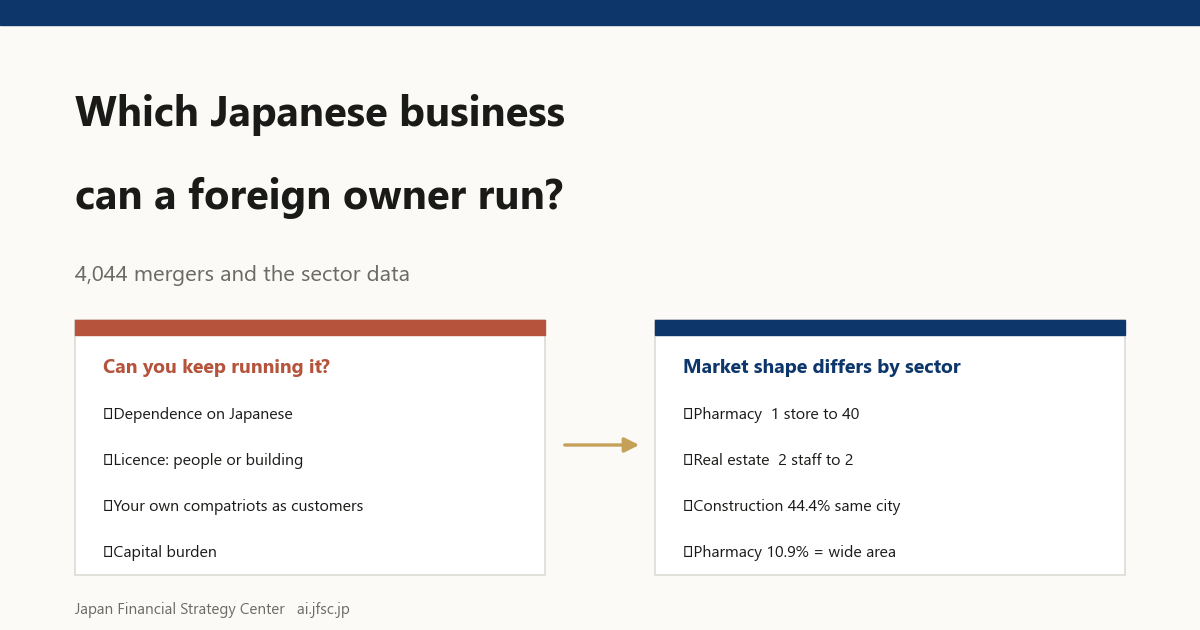
A foreign buyer can acquire a Japanese company in most sectors. The question is not whether you can buy one, but whether you can keep running it afterwards. This article approaches that question through 4,044 recorded mergers and Japan's investment statistics. The regulatory part comes last.
From outside Japan it is hard to picture the transaction. What size of company gets sold, to whom, and from how far away?
Japan's National Tax Agency publishes corporate number data that records why each company closed. Extracting "dissolution by merger" and matching it to the surviving corporate number gives you the company that disappeared and the company that absorbed it, as a pair. Across 11 sectors that is 4,044 cases, of which the buyer could be named in 3,977.
Matching both sides against each sector's licence register, for the cases where size could be recovered:
| Sector | Seller (median) | Buyer (median) |
|---|---|---|
| Pharmacy | 1 store (92% had 3 or fewer, n=52) | 40 stores (n=309) |
| Elder care | 3 facilities / capacity 32 (n=35) | 13 facilities / capacity 189 (n=229) |
| Restaurants | 1 store (93% had 3 or fewer, n=30) | 4 stores (n=221) |
| Trucking | 20 vehicles (25% had 10 or fewer, n=97) | 73 vehicles (n=343) |
| Real estate agency | 2 employees (90% had 5 or fewer, n=21) | 2 employees (n=283) |
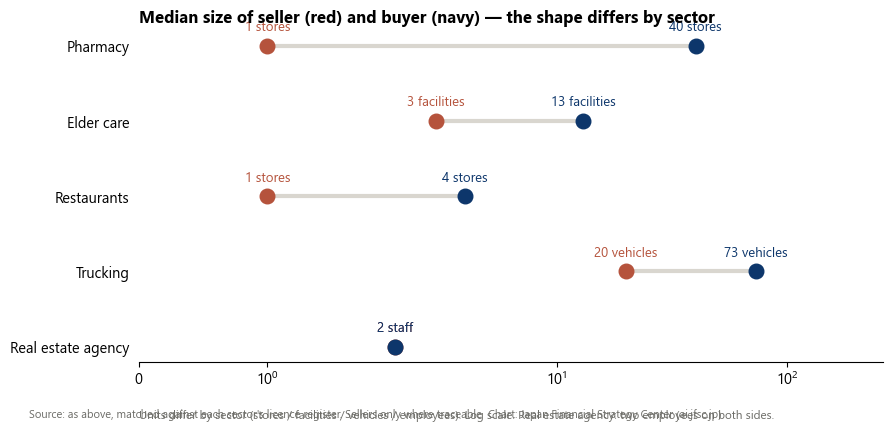
The shape differs by sector.
A pharmacy with one store is absorbed into a 40-store chain. Elder care and trucking run in the same direction. Restaurants show a much smaller gap.
And in real estate agency, both sides have two employees. Companies of the same size combine.
Which side you stand on, as a buyer, changes with the sector.
A company that disappears in a merger also disappears from the licence register. So the seller's size is usually unrecoverable.
| Sector | Sellers still traceable in the register |
|---|---|
| Trucking | 14.0% (99/709) |
| Elder care | 10.1% (35/346) |
| Pharmacy | 9.4% (52/555) |
| Restaurants | 6.8% (30/443) |
| Real estate agency | 3.0% (21/708) |
| Construction | 0.6% (4/660) |
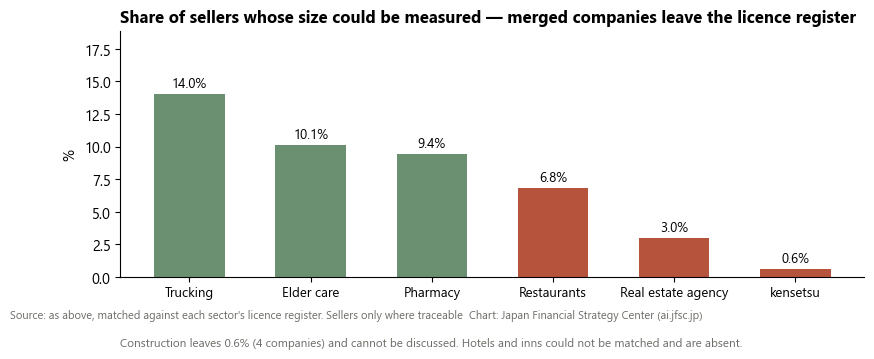
Seller size can be discussed for trucking, elder care, pharmacy and restaurants. Construction leaves four companies, so we do not discuss it. Hotels and inns could not be matched on the seller side at all and do not appear in the table. Buyer size is available for every sector.
After size, distance. Excluding intra-group reorganisations, here is the share of third-party successions where the buyer was in the same municipality as the seller.
| Sector | Third-party successions | Same municipality |
|---|---|---|
| Construction | 342 | 44.4% |
| Elder care | 241 | 40.2% |
| Restaurants | 185 | 34.1% |
| Auto repair | 72 | 33.3% |
| Industrial waste | 36 | 33.3% |
| Real estate agency | 242 | 32.6% |
| Hotels and inns | 151 | 29.1% |
| Trucking | 276 | 21.7% |
| Pharmacy | 450 | 10.9% |
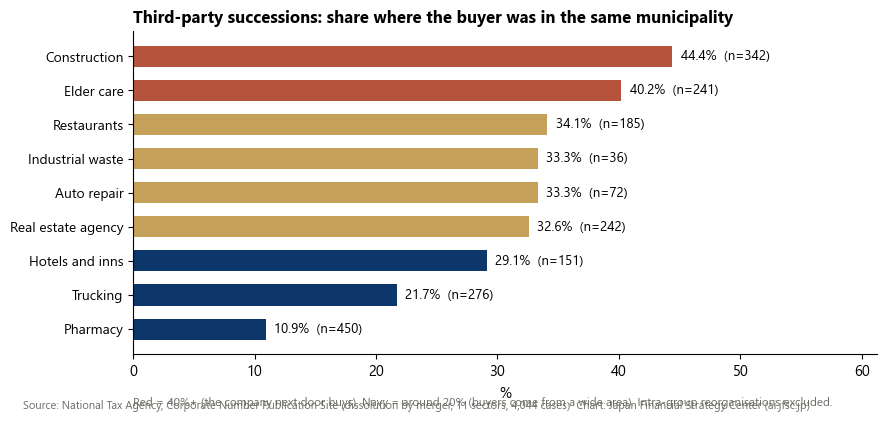
In construction and elder care, four in ten businesses pass to a buyer in the same municipality. The company next door buys it.
Pharmacy is 10.9%. Nine buyers in ten come from somewhere else. National chains pick up stores across the country.
For a buyer arriving from outside, this is a difference in who you are competing with. In neighbourhood markets, sellers often hand the business to someone they already know. Without local ties, that is a wall.
Hotels and inns sit at 29.1%, meaning seven buyers in ten come from outside the municipality. It is not a market that depends heavily on local introductions.
Everything above applies whether the buyer is Japanese or not. From here it changes.
If you are going to buy a Japanese company and run it yourself, capital alone is not enough. Four constraints, in the order they bite.
In some sectors the work only functions in Japanese.
Elder care, logistics, building maintenance. All labour-intensive, and the work turns on conversation at the site: handing over a resident's condition, rearranging a delivery route, changing a cleaning procedure. Put an interpreter in the middle and the speed drops; below a certain speed the operation stops working.
In other sectors, the customers themselves are foreign. There, not speaking Japanese is not a deduction.
The question is not only whether a licence transfers, but whether you can hold on to it afterwards.
Japan's elder-care designation is tied to staffing ratios. A minimum number of qualified staff is a condition of the designation, so if several of them leave, the designation itself is at risk. Staff leaving when ownership changes is a common event.
A trucking depot requires a certified operations manager. Again, tied to a person.
An inn licence, by contrast, is based mainly on the physical facility: room size, ventilation, bathing equipment. None of that changes when staff turn over. It is a licence that tolerates personnel change.
Does the buyer's language and home-country network translate directly into revenue?
Elder-care users are elderly Japanese. Construction clients are Japanese firms. A foreign language is not an asset there.
Accommodation is different. A large share of guests arrive from abroad. If the buyer speaks Chinese or English, that is a strength rather than a gap.
Here we are going to be straightforward. This is the one axis for which we could not produce sector-level figures.
Sectors that come with a building require a large acquisition sum, and refurbishment and equipment renewal continue afterwards. Accommodation is the clearest case. Restaurants and retail operate store by store and can be entered with much less.
We tried to quantify this by sector and could not find a usable primary source. The National Tax Agency's corporate sample survey groups "restaurants, lodging and eating places" together, so restaurants and inns are combined. In that grouping, 95.8% of companies are capitalised at ¥20 million or below — but that figure is pulled down by a very large number of small restaurants and does not describe lodging on its own.
Only a sense of scale is available. Under the Ministry of Health, Labour and Welfare's report on health administration, licensed hotel and inn operations numbered 52,946 facilities with 1,782,232 rooms at the end of FY2024 — an average of 33.7 rooms per facility. What acquiring a 33-room building costs is left to the reader.
This fourth constraint stays qualitative. Without figures behind it, that is the accurate way to present it.
Before testing those four constraints against real data, something has to be separated out.
There are three entirely different layers inside "foreigners doing business in Japan." Mixing them makes the numbers meaningless.
Bank of Japan figures, outstanding balance at end-2025, in hundreds of millions of yen (億円).
| Country / region | Balance | Largest sector |
|---|---|---|
| United States | 87,650 | — |
| Singapore | 53,971 | Finance and insurance 69.8% |
| Hong Kong | 28,594 | Chemicals and pharmaceuticals 36.5% |
| Taiwan | 17,031 | Electrical machinery 36.2% |
| Mainland China | 4,832 | Electrical machinery 9.6% / Chemicals 8.0% / Services 6.5% / Real estate 4.1% |
| (All regions) | 340,053 | — |
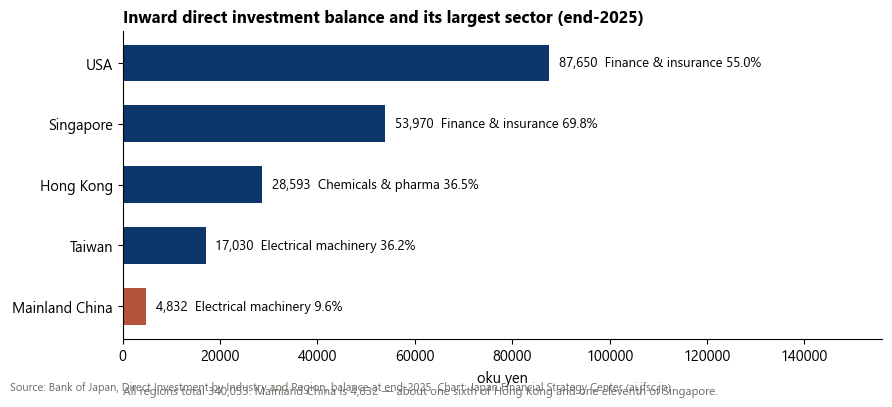
"Chinese money is buying Japan" is a common phrase, but the contents are entirely different. Hong Kong concentrates in pharmaceuticals, Taiwan in electrical machinery, Singapore in finance. And mainland China does not stand out by amount — one sixth of Hong Kong, one eleventh of Singapore.
Mainland China also differs in how the money is distributed. Share of non-manufacturing, by year:
| 2023 | 2024 | 2025 | Balance | |
|---|---|---|---|---|
| Mainland China | 82% | 80% | 76% | 75% |
| Hong Kong | 61% | 79% | 34% | 54% |
| Taiwan | 44% | 71% | 61% | 63% |
Hong Kong and Taiwan swing widely year to year — a single large deal moves the ratio. Only mainland China stays around 80% every year.
In the 2025 flow, non-manufacturing breaks down as real estate ¥7.71bn, services ¥7.50bn, wholesale and retail ¥3.28bn, while telecommunications (−¥2.21bn) and finance and insurance (−¥1.15bn) were net withdrawals.
That is as far as the data goes. Inward direct investment from mainland China remains predominantly non-manufacturing; it is not a picture of large manufacturing investment only.
What the statistic cannot tell you is who is investing. Non-manufacturing does not mean private money. State-owned enterprises investing in services, fund-routed investment, and reinvestment by Chinese-affiliated companies already operating in Japan all sit in the same bucket. Without a source broken down by investor type, that distinction cannot be drawn.
46,781 people at the end of December 2025.
| Nationality / region | People | Share |
|---|---|---|
| China | 24,840 | 53.1% |
| Nepal | 3,158 | 6.8% |
| Pakistan | 3,014 | 6.4% |
| Vietnam | 3,005 | 6.4% |
| South Korea | 2,728 | 5.8% |
| Sri Lanka | 2,617 | 5.6% |
| Taiwan | 1,416 | 3.0% |
| United States | 728 | 1.6% |
Chinese nationals account for 53.1%. Their destinations are Tokyo (7,496, 30.2%) and Osaka (6,829, 27.5%) — 57.7% in those two prefectures.
Layer 1 and Layer 2 do not overlap. By amount, the US and Singapore dominate; by headcount, China and Nepal. The same phrase, "foreign investment," is pointing at different people.
A survey of 619 foreign business owners by the Japan Finance Corporation Research Institute.
| Sector | Share | Sector | Share | |
|---|---|---|---|---|
| Wholesale | 39.3% | Construction | 3.1% | |
| Information and communications | 13.7% | Personal services | 3.1% | |
| Retail | 11.1% | Transport | 2.9% | |
| Manufacturing | 10.7% | Accommodation | 1.0% | |
| Professional and technical services | 5.3% | |||
| Restaurants | 4.8% |
Wholesale is four in ten. Accommodation is 1.0%.
This survey was conducted in October 2020, when COVID-19 was hitting the accommodation sector hardest, and it does not include the subsequent recovery in inbound travel. It does not describe 2026. Read it as "in the available survey it was 1.0%," not "it is still 1%."
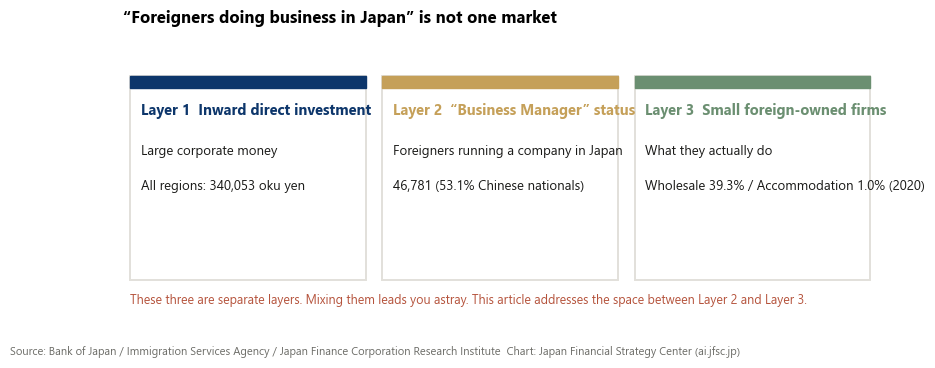
Not the large investment of Layer 1. This article is about someone living abroad, or a foreign resident of Japan, acquiring a Japanese SME and running it themselves — the people between Layers 2 and 3.
| Sector | Depends on Japanese | Licence tied to | Own compatriots as customers | Capital burden |
|---|---|---|---|---|
| Elder care | High | People (staffing ratios) | No | Medium |
| Logistics / trucking | High | People (operations manager) | No | Medium |
| Building maintenance | High | People | No | Light |
| Restaurants | Medium | Facility | Partly | Light |
| Accommodation (hotels, inns) | Low | Facility | Yes | Heavy |
Accommodation earns from the building and its operation, not from headcount. A large share of guests come from abroad, so not speaking Japanese is not a deduction. The inn licence is based mainly on the facility, so it tolerates staff turnover.
Only the last column is unfavourable.
For a foreign owner, accommodation scores well on the operational constraints — language, licence, customers — while carrying a heavy capital burden.
Not "recommended for foreigners," and not "the most profitable." It has two faces, and understood on those terms it can be worth considering.
At first glance it does. If the fit is that good, more people would be doing it.
But the two measure different things. The four constraints ask whether you can keep operating after you buy. The Layer 3 survey counts which sectors people currently operate in. It was not designed to measure which sector is rational to acquire. Different populations.
With that said, reasons the 1.0% could be low:
So it is less "rational but nobody does it" and more "entry is not limited to acquisition, and capital is the binding constraint, so it does not show up in this statistic."
Accommodation swings with the economy and with tourism demand, more than the other sectors here.
In the merger data, 298 hotel and inn mergers break down into 144 intra-group reorganisations (48.8%) and 151 third-party successions. Of the third-party cases, 29.1% had a buyer in the same municipality — seven in ten came from outside. This is not a market closed to outside buyers.
That said, these figures cover only transactions structured as mergers. Share transfers and business transfers do not appear in corporate number data. We are looking at part of the market.
This matters after you have chosen a sector, so it comes last.
Some acquisitions require prior notification. Comparing the count across major economies, Japan stands out.
| Country | Mandatory prior notifications |
|---|---|
| Japan | 2,903 |
| United Kingdom | 753 |
| Italy | 577 |
| Germany | 342 |
| United States | 261 |
| France | 135 |
| Canada | 6 |
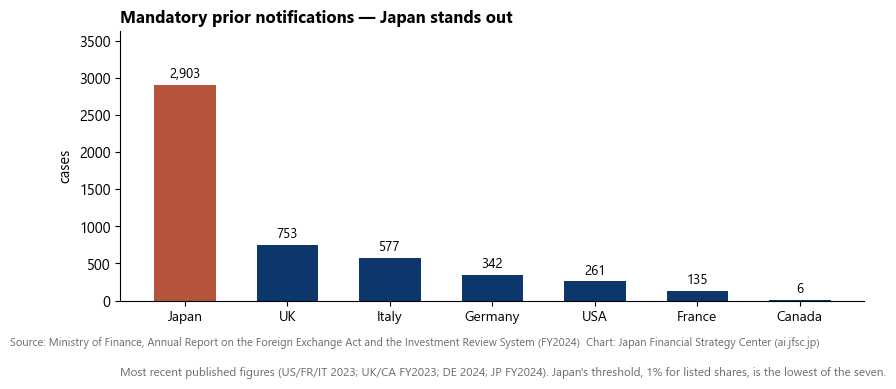
The ownership threshold that triggers notification is also the lowest of the seven: 1% for listed companies in Japan.
This applies only to "designated business sectors": weapons, aircraft, nuclear power, space, telecommunications, water supply, railways, petroleum, heat supply, air transport, maritime transport, manufacture of pharmaceuticals for infectious diseases, manufacture of highly controlled medical devices, electricity, gas, broadcasting, passenger transport, security services, agriculture, forestry and fisheries, leather-related industries, and others. Cyber-security-related sectors (information processing services, software, integrated circuits) account for 56% of notifications.
Conversely, if the target is not in a designated sector, no prior notification is needed — a post-acquisition report is enough. Accommodation is not a designated sector.
The requirements for the "Business Manager" residence status changed on 16 October 2025: stated capital of ¥30 million or more, and at least one full-time employee. Existing holders have a transitional period until 16 October 2028.
The ¥30 million is judged on "the amount of stated capital." It does not mean new cash must be raised. We set out the detail from the statutory text in a separate article.
If the seller of real estate is a non-resident, the buyer takes on a withholding obligation at 10.21% including the special income tax for reconstruction. The exception is narrow: an individual buying for their own or a relative's residence, where the consideration is ¥100 million or less.
Also: acquiring real estate does not grant a residence status. Separate systems.
What is above is general. Which company you can actually buy depends on the particulars.
We work with businesses brought to us directly by Japanese SME owners — not listings on a marketplace, but one at a time.
Please contact us through the inquiry form in your language. The forms are labelled in both the local language and English, and you may write in either.
We reply by email. Given the time difference, phone contact is limited to Japanese business hours, so we ask that correspondence go by email.
Q. Can a foreigner buy a Japanese company?
In most sectors, yes. If the target falls within a designated business sector defined by Ministry of Finance notification, prior notification and screening are required; otherwise a post-acquisition report suffices. But being able to buy and being able to keep operating are separate questions.
Q. Can I run a business without speaking Japanese?
It depends on the sector. Elder care, logistics and building maintenance run on Japanese-language communication at the site and are difficult without it. In accommodation, where a large share of guests come from abroad, not speaking Japanese is not a deduction.
Q. Can licences be transferred?
Ask not only whether a licence transfers but whether you can hold it. Japan's elder-care designation is tied to staffing ratios, so losing qualified staff puts the designation at risk. An inn licence is based mainly on the physical facility and tolerates personnel change.
Q. Which sector is most profitable?
This article does not answer that. It answers which sector is easiest to keep operating after acquisition. Run through the four constraints, accommodation comes out on top — with a heavier capital burden than the others.
Q. How large is a Japanese SME?
It varies by sector. In pharmacy, a one-store company passes to a 40-store chain; in real estate agency, companies with two employees combine with each other. That is from 4,044 mergers across 11 sectors.
Q. Am I at a disadvantage without local connections?
It depends on the sector. In construction 44.4% and in elder care 40.2% of third-party successions went to a buyer in the same municipality. Pharmacy was 10.9% and hotels and inns 29.1%. Some markets depend far less on local ties.
Q. What do I need in order to live in Japan and run the business?
The "Business Manager" residence status. Since 16 October 2025 it requires stated capital of ¥30 million or more and at least one full-time employee. Existing holders have until 16 October 2028 under transitional measures.
Q. Anything to watch for when real estate is part of the deal?
If the seller is a non-resident, the buyer has a 10.21% withholding obligation (except where an individual buys for their own or a relative's residence and the consideration is ¥100 million or less). And acquiring real estate does not grant a residence status.
Merger data
Investment statistics
Residence status and foreign business owners
Regulation

This article is compiled from published data of Japan's National Tax Agency Corporate Number Publication Site, materials published by the Bank of Japan, the Ministry of Finance, the Immigration Services Agency, the National Tax Agency and the Ministry of Health, Labour and Welfare, a survey by the Japan Finance Corporation Research Institute, and statutory text from e-Gov. It does not determine or guarantee the outcome of any particular transaction.
The merger figures cover only transactions structured as mergers; share transfers and business transfers are not included. Seller size is limited to cases matched against a licence register, and in some sectors the base is very small. These limits are stated at the relevant points in the text.
Under Japanese law, preparing licence-succession and residence-status applications is reserved to qualified professionals. This article explains the data and the framework; it does not prepare filings or act as an agent.
Errors are possible. If you notice one, please tell us via the contact form and we will check and correct it promptly.
横にスクロールして拡大部分を見られます。クリックで閉じる