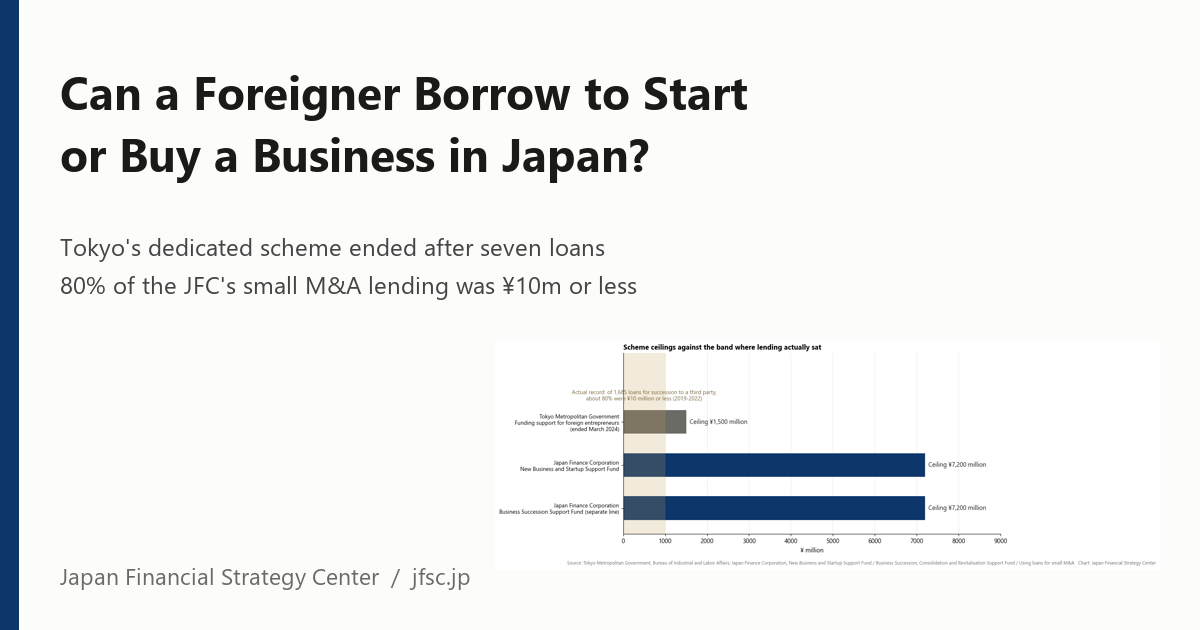
I want to start a company in Japan. Or I want to buy a Japanese company and run it. When people living outside Japan write to us with that plan, the question of money always follows. Will a Japanese bank lend to a foreigner? Will they look at the earnings of the company being bought and lend the rest of the price? How much of my own money do I need?
This article sets out what the published sources say, and nothing more. Lending criteria are not published, so we do not speculate about how an application is assessed. We put the text of each scheme next to the figures each institution has published.
The phrase "small M&A lending" in the title refers to something specific: the breakdown the Japan Finance Corporation published for 1,685 loans for succession to a third party, drawn from its Business Succession, Consolidation and Revitalisation Support Fund (Micro Business and Individual Unit) for the years 2019 to 2022. It is not the whole of the corporation's M&A-related lending.
"Can I borrow" does not have a single answer, because it contains three different questions. Am I allowed to apply? What is the ceiling of the scheme? How much was actually lent? These are three separate numbers, and the guidance page of a scheme usually shows only the first two. This article goes as far as the third.
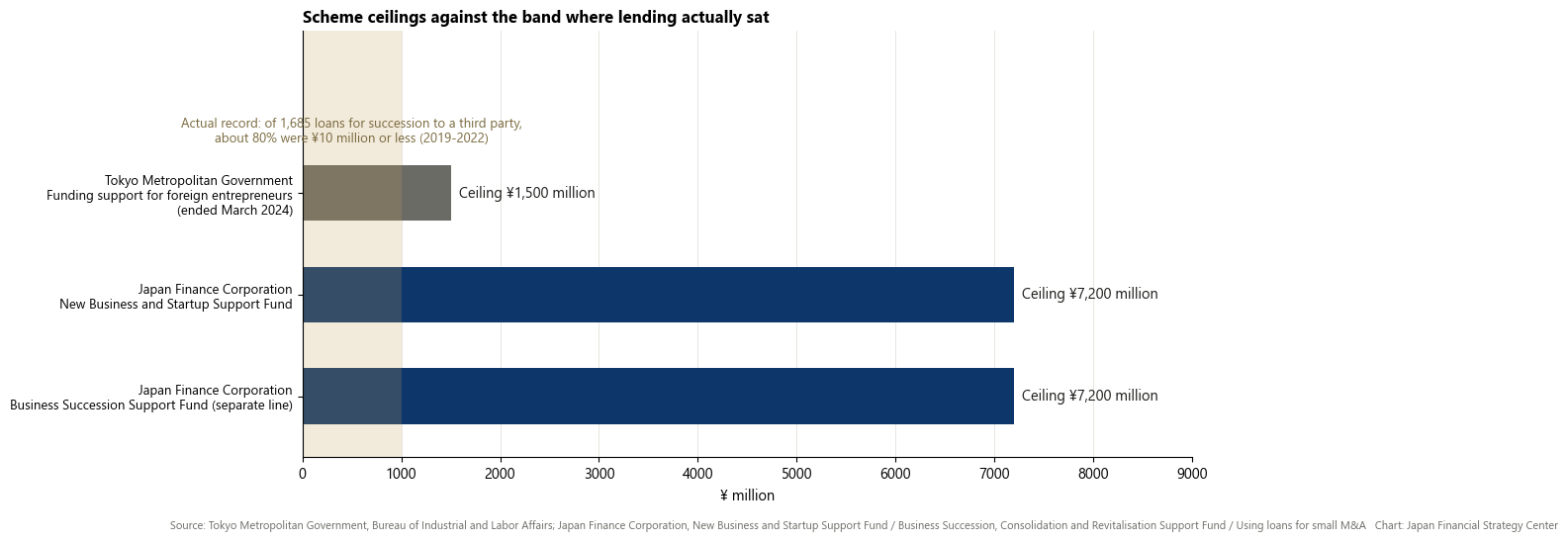
The Tokyo Metropolitan Government ran a funding support programme for foreign entrepreneurs. It combined a loan from a bank with management support before and after the loan, so that foreigners would find it easier to start a business in Tokyo. The terms were as follows.
| Item | Terms |
|---|---|
| Maximum loan | ¥15 million (¥7.5 million if working capital only) |
| Repayment period | Up to 10 years (including a grace period of up to 3 years) |
| Interest rate | Fixed, up to 2.7% |
| Guarantor | The representative director of the company, as a rule |
| Collateral | None |
| Participating institutions | Kiraboshi Bank, Daiichi Kangyo Credit Cooperative |
There were four eligibility conditions. The business plan had to be certified by the Tokyo Metropolitan Government's Office for Startup and Global Financial City Strategy. The company had to be less than five years old. The applicant had to hold a residence status that is not subject to restrictions on business activity. And the applicant had to be the representative of a company whose head office or principal office was in Tokyo.
The lending ended in March 2024. On the same page, Tokyo records the result in a single line.
Loans made under the funding support programme for foreign entrepreneurs: 7 loans, ¥60.5 million
That is about ¥8.6 million per loan. The reason the programme ended is not stated in the published material. Neither is the date it began. What can be said is this: a lending scheme aimed specifically at foreign entrepreneurs was set up through two financial institutions, and it ended having made seven loans.
Lower down the same page, Tokyo lists two other schemes for comparison: its own support programme for women, young and senior founders, and the new business lending of the Japan Finance Corporation. The next section is about that corporation.
The New Business and Startup Support Fund of the Japan Finance Corporation (Micro Business and Individual Unit) has a ceiling of ¥72 million, of which up to ¥48 million may be working capital. Capital expenditure is repayable over up to 20 years and working capital over up to 10 years, each including a grace period of up to five years. Among those eligible for the preferential rate is "a person who is a designated foreign entrepreneur under the programme for promoting entrepreneurial activity by foreign nationals and is starting a new business."
The page describing the scheme states no requirement as to nationality or residence status. Neither does the application guidance page, nor the nine-page Q&A on applying online, as checked on 22 September 2026.
Ask the corporation's business loan enquiry chat about residence status, however, and the answer is this.
In addition to those holding "Permanent Resident", "Spouse or Child of Japanese National", "Spouse or Child of Permanent Resident" or "Long-Term Resident", which are not subject to restrictions on the scope of activity, those holding "Business Manager", a status that is subject to such restrictions, may apply. Please use the online application. Please note that we may be unable to meet your request depending on the outcome of the assessment.
Tokyo's scheme required a residence status free of restrictions on business activity. The corporation's chat includes "Business Manager", which is restricted, among those who may apply. The same foreigner meets a different line depending on the scheme.
The answer says "may apply", and then immediately says the outcome may not meet the applicant's wishes. Residence status is the condition at the door. Behind the door is an assessment of the business plan, the use of the money and the prospect of repayment. Being allowed to apply and being able to borrow are separated in the corporation's own wording.
One more point. The "designated foreign entrepreneur" named on the guidance page as eligible for the preferential rate is someone preparing to start a business under the programme for promoting entrepreneurial activity by foreign nationals. That category does not appear among the residence statuses the chat named. How the two connect could not be read from the published material at hand.
Starting a business in Japan does not only mean forming a company. You can buy an existing company or business and become its owner, and the corporation's schemes treat the two separately.
The Business Succession, Consolidation and Revitalisation Support Fund covers those carrying out a succession or consolidation of a business, and those whose business is being succeeded. Its ceiling is ¥72 million on a separate line from the startup fund, with capital expenditure repayable over up to 20 years and working capital over up to 10 years, each with a grace period of up to five years. Capital expenditure here includes the shares, goodwill and business assets bought from the transferring company.
The corporation illustrates how the money is used with four cases.
Only the first two are loans for the purchase price itself. The other two are money needed after the purchase. What it costs to buy a company is not only the price of the company, and the corporation's choice of examples shows it.
This is the part worth checking most carefully.
The ceiling is ¥72 million. The corporation has published a breakdown of 1,685 loans for succession to a third party, taken from the same fund for 2019 to 2022.
| Measure | Breakdown |
|---|---|
| Loan size | For both working capital and capital expenditure, about 60-70% were ¥5 million or less, and about 80% were ¥10 million or less |
| Employees | 80% had five employees or fewer, about 90% had twenty or fewer |
| Sector | Transport was the largest at about 30%, followed by wholesale and retail, services, restaurants and accommodation |
| Form | 70% of loans went to sole proprietorships, 30% to companies |
| Co-financing | About 20% were co-financed with a private financial institution |
A scheme with a ceiling of ¥72 million, and 80% of its loans at ¥10 million or less. The two are not in conflict. The amount of a loan is decided case by case from the size of the business, the use of the money and the business plan. But read the ceiling as the amount you can raise, and you are an order of magnitude away from the record.
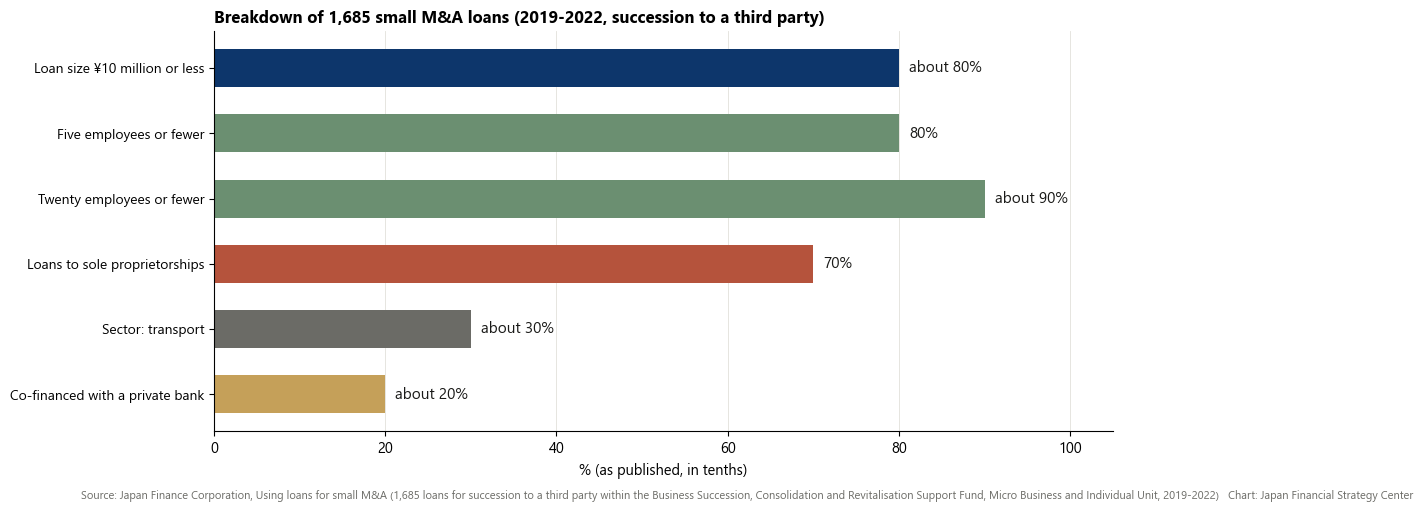
The corporation itself writes that where M&A funding is large, several financial institutions may lend together, and about 20% of these loans were co-financed with a private institution. Splitting a large purchase price across institutions rather than taking it all from the corporation appears in the published record.
These 1,685 loans are not a count of foreigners. The corporation does not publish a breakdown of borrowers by nationality, so how many of them went to foreign buyers is unknown. What the figures show is the scale at which this lending scheme operates.
So far we have looked from the lending side. Now back up a step. To live in Japan in order to run your own company you need the Business Manager residence status, the same status the corporation's chat named among those who may apply. Its criteria set a level of funding before any loan application is made.
The criteria changed with an amendment that took effect on 16 October 2025.
| Item | Before | After |
|---|---|---|
| Capital or total contribution | ¥5 million | ¥30 million or more |
| Career or education | None | Three years of business management experience, or a master's-level degree in management or a related field |
| Employment | None (two or more employees as an alternative to capital) | At least one full-time employee |
| Japanese ability | None | The applicant or a full-time employee at a reasonable level (equivalent to CEFR B2) |
| Business plan | None | Confirmation by a person with professional knowledge of management: a certified SME management consultant, certified public accountant or tax accountant |
Those who already held Business Manager status before the amendment will be asked to meet the new criteria, in principle, from the first extension of period of stay after three years from the date it took effect. The Immigration Services Agency's Q&A rejects, as "not true", the reading that a person must leave Japan if they cannot produce ¥30 million within those three years. At an extension after the three years, it says, the overall situation is considered, including whether the business is being run soundly, whether corporate tax and other obligations have been met, and whether the criteria are likely to be met by the next renewal.
Three points bear directly on a funding plan.
First, what the ¥30 million consists of. For a kabushiki kaisha (KK) it is the amount of paid-in capital; for a general partnership, limited partnership or godo kaisha (GK) it is the total contribution. For a sole proprietor it is not capital at all, but the total invested in what the business needs: securing premises, one year of staff salaries, capital expenditure and the like.
Second, whether that ¥30 million can be borrowed. No general statement on whether borrowed money may be put in as capital could be found in the published material. What could be found is narrow: for money paid in on the issue of share options, the portion that satisfies conditions including that it is "a payment with no obligation of repayment" may be counted towards the ¥30 million.
Third, who counts as a full-time employee. Only Japanese nationals, special permanent residents, and holders of the statuses in Appendix II of the Immigration Control Act, namely "Permanent Resident", "Spouse or Child of Japanese National", "Spouse or Child of Permanent Resident" and "Long-Term Resident". A foreigner in Japan on a work status does not count towards that one employee. As for premises, using your home as the office as well is not accepted as a rule.
One caution on wording. The "capital or total contribution" of the residence criteria and the applicant's own funds as a lender uses the term are not the same concept. The first is the size of the business, confirmed through the commercial register and similar documents. The second has no published definition that runs across schemes, and meeting the residence criteria does not in itself become an assessment in a lending decision.
Since the residence status asks for money first, the question becomes where the first money comes from. There are two routes.
Borrow from a bank in your home country and bring the money in. If you already bank there, the lender holds information a Japanese institution cannot see: your deposits, your borrowing history, your assets, your income. You can talk in your own language, and you can start before you arrive. Money raised this way is a separate source from anything you borrow later in Japan.
Borrow from a Japanese institution. Here the business you are starting, or the company you are buying, is what gets assessed. The corporation's startup and M&A lending sit on this side. It requires explaining a business plan in Japanese and working through the paperwork.
Neither route is the better one. The point is that the same word, borrowing, can mean using two different people's credit.
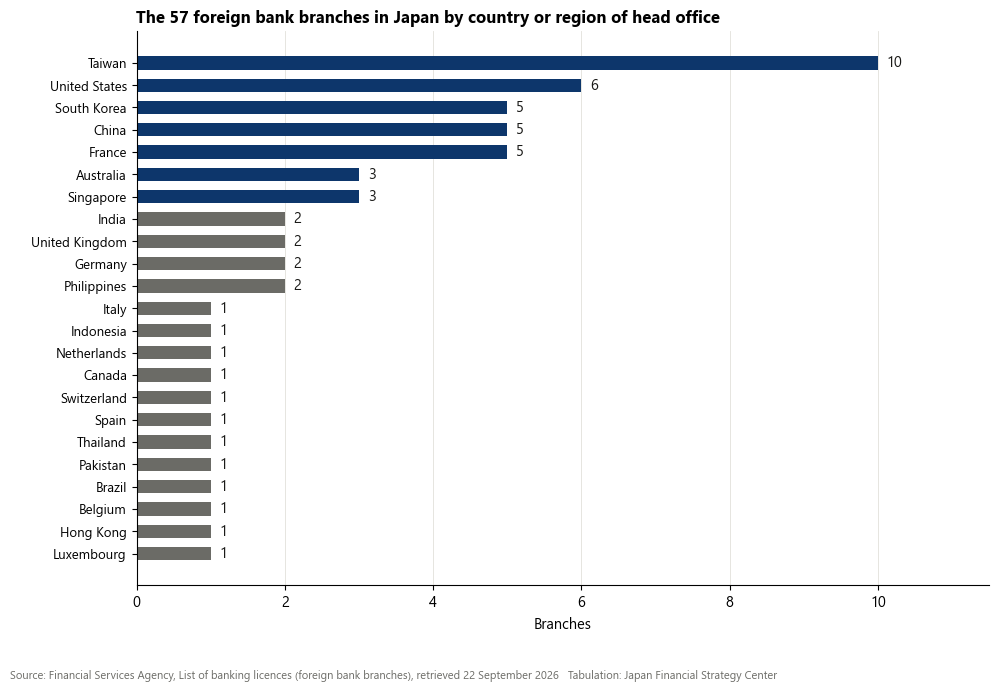
Japan also has branches of foreign banks. Counted from the Financial Services Agency's list of banking licences, retrieved on 22 September 2026, there are 57 foreign bank branches. By the country or region of the head office: Taiwan 10, the United States 6, China 5, South Korea 5, France 5, Singapore 3, Australia 3, and so on. This is a list of licences, though, not a list of startup lending desks. What each branch does in Japan differs from bank to bank, and whether an individual can raise startup funding there cannot be read from this list.
That the company you are buying earns money can matter when a Japanese institution considers a loan. It does not settle the matter on its own. Who is borrowing, whether that is the buyer personally, the buyer's company or the company being bought; what the money is for, whether that is acquiring shares, acquiring goodwill and equipment, or working capital after the purchase; and what happens with collateral and guarantees. The corporation's four examples divided along exactly these lines.
So far we have mostly assumed someone who has yet to arrive in Japan. Change the circumstances and the premises change.
Neither "foreigners cannot borrow" nor "the scheme exists, so you can borrow" comes out of the published material. The schemes exist, the condition at the door differs from scheme to scheme, and whether money is actually lent returns to the circumstances of the case. That is as far as published sources go; beyond it is a matter of applying this to your own situation.
Q. Will a lender look at the earnings of the company I am buying and lend me the rest of the price?
That the company earns money can be material to the decision. It does not decide it on its own. The Japan Finance Corporation describes M&A funding by use: acquiring shares, acquiring goodwill and business assets, and equipment or working capital after the purchase. Set out who is borrowing and what the money is for, and it becomes a case-by-case assessment.
Q. How much of my own money do I need?
Whether the whole purchase price can be borrowed is decided case by case. No uniform threshold can be found in the published material. The figure that can be cited is the corporation's published record: about 80% of its loans for succession to a third party were ¥10 million or less.
Q. Can I use instalment payments to the seller?
This is not something set out in a scheme; it is a matter of contract between the parties. No published statistics could be found on how often it is used. The terms are a matter for individual negotiation.
Q. Can I apply without a residence status?
The corporation's chat says that holders of "Permanent Resident", "Spouse or Child of Japanese National", "Spouse or Child of Permanent Resident" and "Long-Term Resident", and also holders of "Business Manager", may apply. The scheme's guidance page and the application Q&A say nothing about residence status. For how your own status would be treated, ask the corporation directly.
Q. Can I put borrowed money in as capital?
No published material setting out the general treatment could be found. For money paid in on the issue of share options, the Immigration Services Agency's material states that the portion satisfying conditions including that it is "a payment with no obligation of repayment" may be counted towards the ¥30 million.
Q. Can I run a business without Japanese?
Under the amendment effective 16 October 2025, Business Manager status requires the applicant or a full-time employee to have Japanese at a reasonable level. That means B2 or above on the Framework of Reference for Japanese Language Education, confirmed by JLPT N2 or above, 400 points or more on the BJT Business Japanese Proficiency Test, twenty years or more of residence in Japan as a mid- to long-term resident, graduation from a Japanese university or equivalent, or completion of Japanese compulsory education plus high school. Where the applicant does not meet it, a full-time employee may.

This article sets out material published by the Tokyo Metropolitan Government, the Japan Finance Corporation, the Immigration Services Agency and the Financial Services Agency, read as at 22 September 2026. It does not describe the lending criteria of any financial institution, does not judge whether any particular loan will be granted, and does not recommend any scheme or institution.
Schemes are amended and discontinued, so please confirm the current position with each institution. Questions of residence status, tax and law in your own case belong with the relevant qualified professional.
Errors are possible. If you notice one, please tell us via the contact form and we will check and correct it promptly.
Scroll sideways to see the detail. Click to close